
The paid media landscape is on fire, and not in a good way.
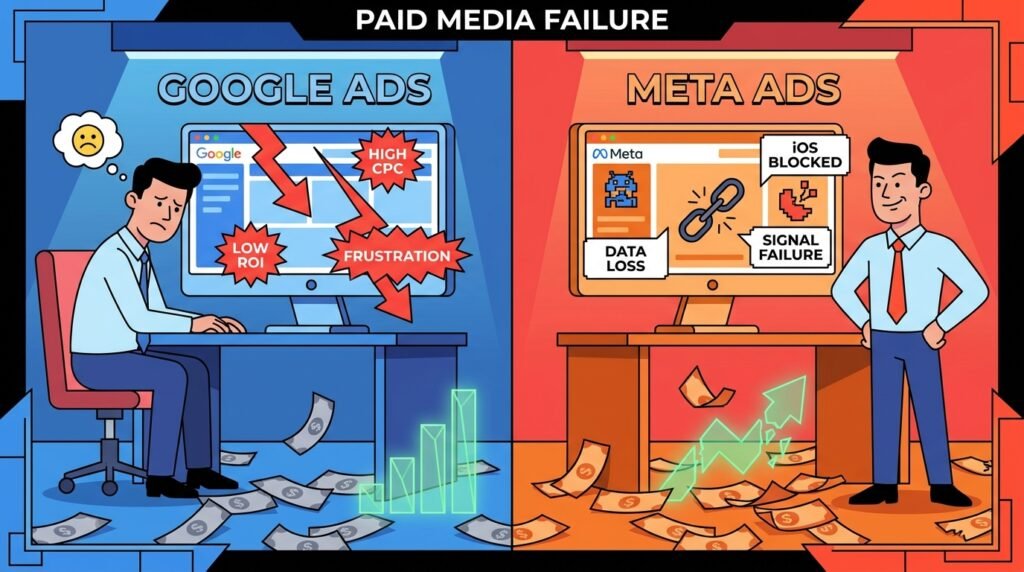
If you feel like you’re pouring money into Google and Meta but the algorithm seems to be working against you rather than for you, you aren’t paranoid. You’re just using a broken playbook.
The dirty secret of digital advertising right now is that paid media and organic search (SEO) are no longer silos. Most advertisers fix a Google Ads problem with a Google Ads tool, and a Meta problem with a Meta patch. But the root cause of your hemorrhaging budget usually lies in a violation of SEO-first principles: intent mismatch, poor information architecture, and lazy content.
Let’s break down the specific problems plaguing both platforms and the unorthodox, SEO-driven techniques to fix them.
Part 1: The Google Ads “Black Hole” (And The SEO Escape Route)
Google Ads is no longer a pay-to-play slot machine. It’s a machine-learning beast that punishes irrelevance more heavily than ever. If your Quality Score is dropping and your CPCs are skyrocketing, it’s likely one of these three SEO-related sins.
Problem 1: The Keyword-to-Landing Page Divorce
The most common Google Ads mistake is sending all paid traffic to a generic “demo request” page, regardless of the search query.
- The Symptom: High Click-Through Rate (CTR), abysmal Conversion Rate (CVR), and a Quality Score of 3–5.
- The SEO Diagnosis: Google’s crawler has “reading blindness” when the semantic intent of the ad doesn’t carry over to the Landing Page’s H1 and body text.
The SEO Technique Fix: The “Semantic Silo” Mirroring
Stop building one landing page for every 10 keywords. Create “Topic Clusters” just like you do for SEO blog content.
If you bid on the keyword “best CRM for dental offices,” your landing page shouldn’t just say “Request a Demo.” The Meta Title tag of that landing page (yes, search ads crawl this) and the H1 must specifically say “CRM Software Built for Dental Offices.” This creates a direct semantic bridge, instantly lifting your Quality Score.
Problem 2: Disregarding “SERP Intent” in Ad Copy
Google uses ad relevance as a major ranking factor for ads. If the organic SERP (Search Engine Results Page) for your target query shows 10 “How-to” guides, and you’re running an aggressive “Buy Now” shopping ad, you’re screaming into the void.
The SEO Technique Fix: Intent Classification
Before writing a single ad, manually search your keyword. Is it Informational, Commercial, or Transactional? SEOs do this daily.
- If the organic results are listicles (“Top 10 Accounting Tools”), your Ad Copy must hook with comparison language (“See Why We’re #1 vs. QuickBooks”).
- Don’t force a hard sell on an information-seeking user. Offer a “Free Checklist” in the ad copy to match the organic intent, then retarget them on Meta later.
Part 2: The Meta Ads “Data Blindness” (And The Signal Reconstruction)
If Google Ads is a demand-capture engine, Meta is a demand-creation engine. The problem? The iOS 14+ privacy update didn’t just limit data; it shattered Meta’s ability to understand who buys. You have to rebuild that targeting signal using “Old School Webmaster” techniques.
Problem 1: The “Black Box” Audience Fungus
You’re relying entirely on Advantage+ shopping campaigns and broad targeting, hoping the algorithm figures it out. But the algorithm is starving for data. It keeps showing your ad to cheap, click-happy profiles that never buy.
The SEO Technique Fix: The Conversion API (CAPI) Hybrid Layer
Server-side tracking via CAPI is the ads equivalent of a clean sitemap for Googlebot. It bypasses browser ad-blockers and cookie restrictions. But the real SEO trick is Enhanced Conversions (First-Party Data upload). When a user converts on your landing page, pass back hashed first-party data (emails, phone numbers) to Meta’s algorithm. You are literally feeding the robot the “link juice” of your customer base, telling it, “Find me more people who smell like this chemical signature.”
Problem 2: Creative Fatigue & Thin Content
You boosted a single image for three months. It has a 3.0 frequency; everyone is sick of seeing it. In the SEO world, this is the equivalent of having a website with only one page of thin content.
The SEO Technique Fix: The “Programmatic Creative” Content Calendar
Treat your ad creative like a blog content calendar. You wouldn’t post one blog in January and expect it to rank in December. Structure your video ads like a topic cluster:
- The Pillar Ad (The Hook): A high-production value explainer video.
- The Cluster Ads (Social Proof): UGC-style raw footage of customers.
- The Bottom-Funnel (The Schema): A simple, static image with a bold statistic.
Switch them out weekly. Meta reads engagement signals (shares, saves) the way Google reads backlinks. A high save rate acts as a “social backlink,” lowering your CPMs drastically.
Problem 3: The Google & Meta Attribution War (Cross-Platform Cannibalism)
This is the killer of all marketing budgets. Google Ads claims the credit for the sale. Meta Ads claims the credit for the same sale. Combined, they report 150% of your actual revenue. You double your budget because ROAS looks great, but your bank account doesn’t reflect it.
The SEO Data Technique Fix: The “Last Non-Direct Click” Model
SEO analysts have known for years that “Direct Traffic” is usually dark social or brand recall from a different channel. Stop looking at “Last Click” in your ad dashboards.
Look at Assisted Conversions. Understand that Meta is your awareness “Top of Funnel” engine. It’s the informational blog post that introduces the brand. Google Brand Search is your closer.
If you see an increase in branded organic search volume for your company name, that is your real Meta Ads ROAS. Don’t optimize Meta for purchase events; optimize it for “Add to Cart” or “Landing Page View” signals, and let SEO and Google Branded search handle the final, low-CPC click.
The Reboot: A Unified Data Strategy
To fix your ad problems, stop thinking like a media buyer and start thinking like a Technical SEO.
- Audit Your Load Speed: Google Ads hates slow pages; Meta’s Instant Experience outperforms a slow mobile site by 90%. Compress your images and fix your Cumulative Layout Shift (CLS) today. A 0.1-second improvement in load time often boosts conversion rates more than a $500 creative test.
- Server-Side Rigor: Install CAPI and Google Tag Manager server containers. This is your new “robots.txt” file. If you don’t have it set up, you are flying blind in a thunderstorm.
- The “Money” Keyword Pivot: Take the search queries converting organically via SEO (from Google Search Console) and put them only into your Google Ads exact match campaigns. You already have proof they work. Amplify them, don’t guess new ones.
The age of the “Golden Ad Manager” clicking buttons in a dashboard is dead. The new age belongs to the hybrid marketer who understands that an algorithm is just a hungry crawler looking for the most relevant, structurally sound digital real estate to put in front of a human. Feed the machine right, and it will stop stealing your lunch money.