If you’re running a business online, you’ve probably heard the terms SEO vs SEM. Many business owners think they’re the same thing. They’re not.
Understanding the difference between SEO and SEM can completely change how you approach digital marketing. One focuses on long-term organic growth. The other delivers faster, paid results. The real question is: which one is right for your business?
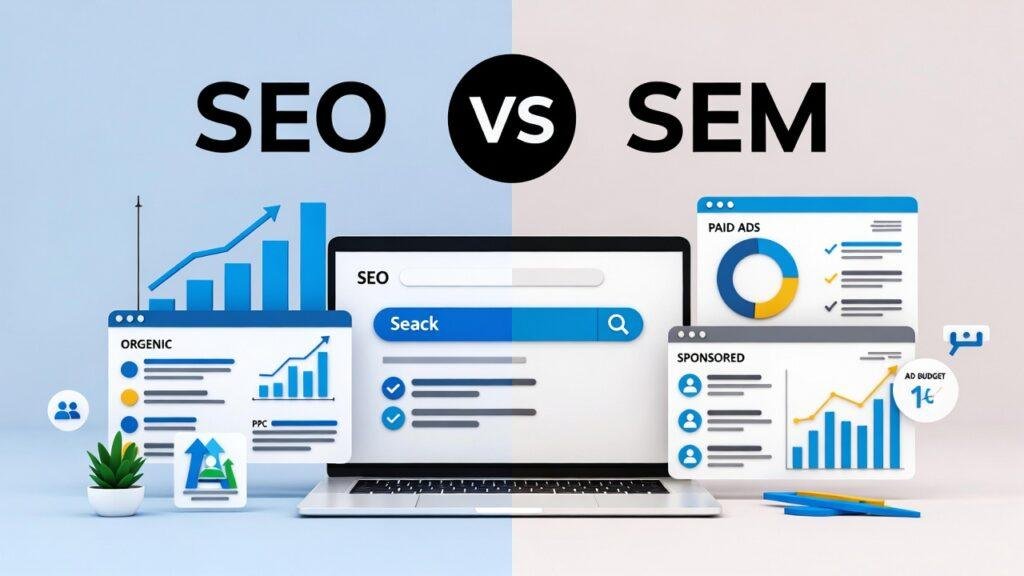
Let’s break it down in a simple and practical way.
What Is SEO?
SEO stands for Search Engine Optimization. It is the process of improving your website so it ranks higher in organic (non-paid) search results on Google.
When someone searches for a product or service related to your business, SEO helps your website appear naturally in those results.
SEO includes:
- Keyword research
- On-page optimization
- Technical improvements
- Content creation
- Link building
- Improving website speed and user experience
The main benefit of SEO is long-term traffic. Once your website ranks, you can generate consistent visitors without paying for every click.
However, SEO takes time. Results usually take 3 to 6 months, sometimes longer depending on competition.
What Is SEM?
SEM stands for Search Engine Marketing. It is a broader term that includes paid search advertising, mainly through platforms like Google Ads.
When you run SEM campaigns, you bid on keywords and your website appears at the top of search results as a sponsored listing.
With SEM, you:
- Create paid ads
- Target specific keywords
- Set a budget
- Pay per click
The biggest advantage of SEM is speed. You can start getting traffic immediately after launching a campaign.
The downside? The moment you stop paying, the traffic stops.
SEO vs SEM: The Core Differences
Now let’s compare SEO vs SEM clearly.
1. Cost Structure
SEO requires investment in content, technical optimization, and strategy. But you don’t pay for each click.
SEM requires ongoing ad spend. You pay every time someone clicks your ad.
If you want predictable long-term traffic, SEO is more cost-effective. If you want instant visibility, SEM works faster.
2. Time to See Results
SEO is a long-term strategy. It builds authority and credibility over time.
SEM produces immediate results. You can appear on page one within hours.
Businesses that need quick leads often start with SEM while building SEO in the background.
3. Trust and Credibility
Users tend to trust organic results more than ads. Ranking organically builds authority.
Paid ads are visible, but many users scroll past them.
For brand trust, SEO often has the edge.
4. Sustainability
SEO creates long-term digital assets. Your content keeps working for you.
SEM stops working when the budget ends.
That’s why smart businesses rarely choose only one.
Which Is Better: SEO or SEM?
The real answer in the SEO vs SEM debate is this: it depends on your goals.
Choose SEO if:
- You want long-term growth
- You want consistent organic traffic
- You want to build brand authority
- You have time to invest
Choose SEM if:
- You need immediate leads
- You’re launching a new product
- You’re testing a new market
- You want fast visibility
The strongest strategy is combining both.
At EcommeLogic, we often recommend starting with paid ads to generate quick data and revenue, while building an SEO foundation for long-term stability.
Why Most Businesses Fail With SEO and SEM
Here’s the mistake we see frequently.
Business owners increase their ad budget without fixing their website. They focus on traffic instead of conversions.
Whether you choose SEO or SEM, your website must be optimized for:
- Clear messaging
- Fast loading speed
- Mobile responsiveness
- Strong call-to-action
- Conversion-focused design
Without this, both SEO and SEM will underperform.
Traffic alone does not generate sales. A strong system does.
Final Thoughts on SEO vs SEM
The SEO vs SEM discussion is not about choosing one over the other. It’s about using the right strategy at the right time.
SEO builds authority and long-term growth.
SEM drives fast traffic and quick results.
If your goal is sustainable business growth, you need a balanced digital marketing strategy that aligns with your budget, timeline, and objectives.
At EcommeLogic, we help businesses design strategies that combine high-converting websites, search engine optimization, and paid advertising to maximize ROI.
If you’re unsure whether SEO, SEM, or a combination of both is right for your business, the first step is analyzing your current website and marketing funnel.
Because growth doesn’t come from spending more.
It comes from building smarter systems.