
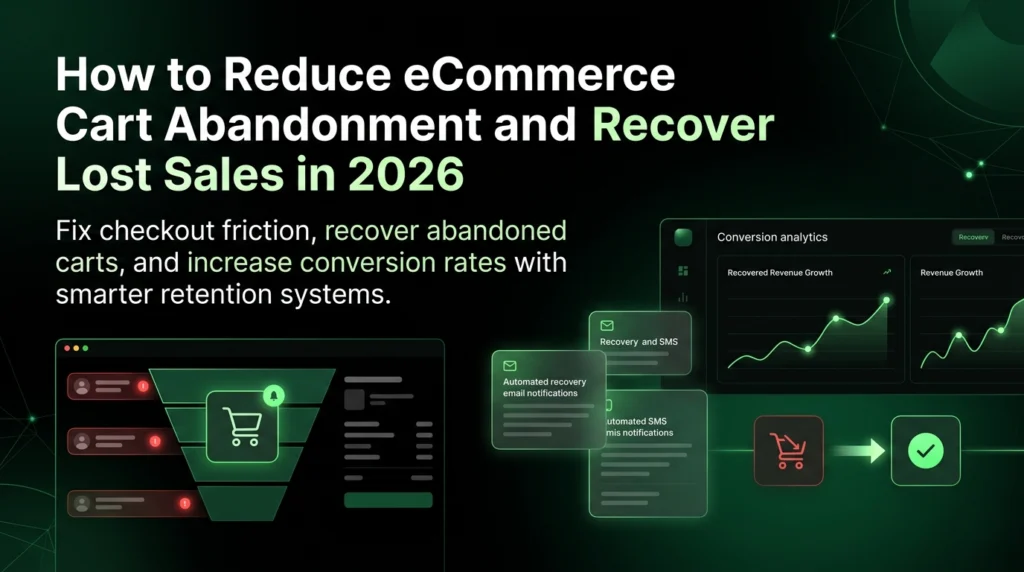
Did you know that nearly 70% of online shoppers abandon their cart before completing a purchase? That means for every 10 customers who show genuine interest in your products, 7 leave without buying.
For eCommerce store owners across the U.S., cart abandonment is one of the single biggest revenue leaks — and the good news is, most of it is preventable.
In this guide, we’ll break down exactly why customers abandon carts, and the most effective, actionable strategies to reduce eCommerce cart abandonment and recover the sales you’re already losing.
What Is Cart Abandonment (and Why It Matters)?
Cart abandonment happens when a shopper adds one or more items to their online shopping cart but exits the site without completing the purchase.
The average cart abandonment rate across all industries sits around 70.2% (Baymard Institute, 2025). In the U.S. alone, this translates to billions of dollars in lost revenue every single year.
Here’s the thing — most of those lost shoppers were already interested. They browsed, selected, and added to cart. That’s high purchase intent. Which means with the right strategy, a significant portion of them can be brought back.
Top Reasons Shoppers Abandon Their Cart
Before you can fix the problem, you need to understand it. The most common reasons U.S. shoppers abandon their carts include:
- Unexpected costs – Shipping fees, taxes, or fees added at checkout (the #1 reason, per Baymard)
- Forced account creation – Shoppers don’t want to sign up just to buy
- Complicated checkout process – Too many steps, too many form fields
- Slow website or checkout page – A 1-second delay can reduce conversions by 7%
- Concerns about payment security – No trusted payment badges or SSL indicators
- Just browsing / not ready to buy – Some abandonment is natural and unavoidable
- Better price found elsewhere – Comparison shopping is extremely common in the U.S.
Understanding your specific abandonment reasons requires looking at your analytics — tools like Google Analytics 4, Hotjar, or your eCommerce platform’s built-in reporting can reveal where in the checkout funnel shoppers are dropping off.
8 Proven Strategies to Reduce eCommerce Cart Abandonment
1. Be Upfront About All Costs from the Start
The fastest way to kill a sale is a surprise shipping fee at checkout. U.S. consumers have been conditioned by Amazon Prime to expect free (or cheap) shipping — and hidden costs feel like a betrayal.
What to do:
- Display shipping costs (or free shipping thresholds) on product pages
- Offer a free shipping calculator before checkout begins
- Consider building shipping costs into your product pricing and advertising “free shipping” — this psychologically performs better
2. Offer Guest Checkout
Forcing account creation is a conversion killer. A guest checkout option removes a major barrier for first-time buyers.
You can still invite shoppers to create an account after the purchase is complete — at that point, their order details are already filled in, making signup nearly frictionless.
3. Simplify and Speed Up Your Checkout Process
Every extra step is an opportunity to lose the customer. Audit your checkout and ask: Is every field truly necessary?
Best practices:
- Reduce checkout to 3 steps or fewer (Cart → Details → Payment)
- Enable autofill-friendly form fields
- Add progress indicators so shoppers know how close they are to done
- Offer one-click checkout options (Shop Pay, Apple Pay, Google Pay)
4. Build Trust with Security Signals
U.S. shoppers are increasingly cautious about online security. If your checkout doesn’t look trustworthy, they won’t proceed — no matter how much they want the product.
Add these trust signals:
- SSL certificate (HTTPS) and a padlock icon
- Payment logos (Visa, Mastercard, PayPal, Amex)
- Security badges (McAfee, Norton, TrustedSite)
- A clear, easy-to-find return policy link near the “Buy” button
5. Use Exit-Intent Popups
Exit-intent technology detects when a user is about to leave your site and triggers a targeted popup — giving you one last chance to convert them.
Effective exit-intent popup offers include:
- A discount code (“Wait — here’s 10% off your order!”)
- A free shipping offer
- A reminder of what’s in their cart
- Social proof (“4,200+ happy customers this month”)
Keep it simple, relevant, and non-intrusive. A well-timed popup can recover 5–15% of abandoning visitors.
6. Send Abandoned Cart Email Sequences
This is one of the highest-ROI tactics in all of eCommerce marketing. Shoppers who receive abandoned cart emails are 2.4x more likely to complete their purchase compared to those who don’t.
A proven 3-email sequence:
| Timing | Purpose | |
|---|---|---|
| Email 1 | 1 hour after abandonment | Gentle reminder — “You left something behind” |
| Email 2 | 24 hours later | Build urgency — “Items in your cart are selling fast” |
| Email 3 | 48–72 hours later | Offer an incentive — “Here’s 10% off to complete your order” |
Personalize these emails with the actual product names and images from the cart. Tools like Klaviyo, Mailchimp, and Omnisend make this easy to automate for Shopify, WooCommerce, and BigCommerce stores.
7. Retarget Abandoners with Paid Ads
Not every shopper checks their email. Retargeting ads on Meta (Facebook/Instagram) and Google let you re-engage cart abandoners as they browse the web or scroll social media.
Dynamic product ads automatically show users the exact items they left in their cart — a powerful reminder that typically outperforms standard display ads by 3–5x in click-through rate.
Pro tip: Set a frequency cap so you’re not over-serving the same ad and annoying potential customers.
8. Optimize for Mobile Checkout
Over 60% of eCommerce traffic in the U.S. now comes from mobile devices, yet mobile conversion rates lag well behind desktop. A clunky mobile checkout experience is a direct driver of abandonment.
Mobile checkout must-haves:
- Large, tappable buttons (minimum 44px height)
- Auto-zoom disabled on input fields
- Mobile wallets enabled (Apple Pay, Google Pay)
- Fast load times (aim for under 2 seconds on 4G)
- Minimal typing required
How to Measure Your Cart Abandonment Rate
Your cart abandonment rate is calculated as:
Cart Abandonment Rate = (1 – Completed Purchases / Shopping Carts Created) × 100
For example, if 1,000 shoppers add to cart but only 320 complete a purchase:
(1 – 320/1,000) × 100 = 68% abandonment rate
Track this monthly. As you implement the strategies above, you should see this number drop — and your revenue increase — without needing to acquire a single new visitor.
Quick Wins: Start Here
If you’re overwhelmed and don’t know where to start, focus on these three high-impact changes first:
- Enable guest checkout — takes minutes to set up, immediately removes friction
- Launch an abandoned cart email sequence — highest ROI, can be automated
- Display total costs earlier — eliminates your #1 source of checkout surprises
Final Thoughts
Cart abandonment is frustrating — but it’s also a massive opportunity. Every percentage point you recover from your abandonment rate is pure revenue from traffic you’ve already paid for.
The stores that win in 2026 won’t just focus on getting more traffic. They’ll focus on converting the traffic they already have. And that starts with an optimized, trust-building, friction-free checkout experience.
At EcommeLogic, we help eCommerce brands identify exactly where they’re losing customers — and build smarter systems to convert more of them. Get in touch with our team to see how we can help your store grow.