
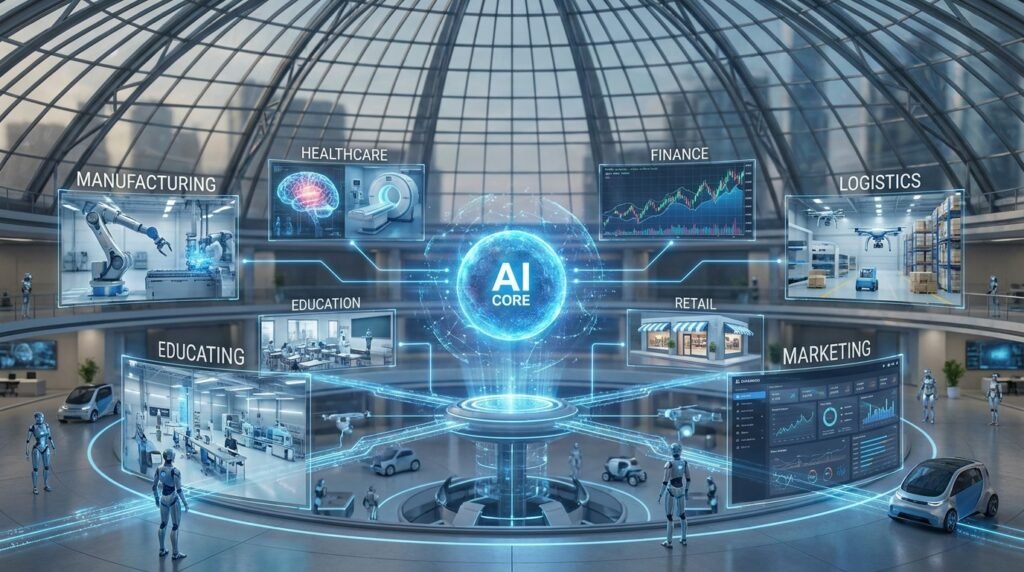
Artificial Intelligence (AI) is transforming industries by automating repetitive tasks, improving decision-making, increasing productivity, and enabling new business models. Industries such as healthcare, finance, manufacturing, education, retail, logistics, and marketing are using AI to improve efficiency, reduce costs, and deliver better customer experiences. However, AI also introduces challenges related to workforce disruption, data privacy, ethics, and implementation costs.
Introduction
Artificial Intelligence has evolved from a futuristic concept into a practical business tool used across nearly every major industry. Organizations are using AI-powered systems to analyze data, automate workflows, improve customer interactions, and accelerate innovation.
From healthcare diagnostics to autonomous supply chains, AI is reshaping how businesses operate and compete. Companies that successfully adopt AI can gain significant advantages in efficiency and decision-making, while those that ignore the technology risk falling behind.
This guide explores the effects of AI on various industries, the benefits it offers, the challenges it creates, and what businesses should expect in the future.
What Is Artificial Intelligence?
Artificial Intelligence refers to computer systems designed to perform tasks that typically require human intelligence.
These tasks include:
- Learning from data
- Understanding language
- Recognizing images
- Solving problems
- Making predictions
- Automating decisions
Modern AI technologies include:
- Machine Learning (ML)
- Deep Learning
- Natural Language Processing (NLP)
- Computer Vision
- Generative AI
These technologies enable businesses to automate complex processes and extract valuable insights from large amounts of data.
Why Is AI Important for Modern Industries?
AI allows organizations to:
- Reduce operational costs
- Improve efficiency
- Increase productivity
- Enhance customer experiences
- Improve forecasting accuracy
- Automate repetitive tasks
- Accelerate innovation
As industries become increasingly data-driven, AI helps businesses process information faster and make better decisions.
AI in Healthcare
Healthcare is one of the industries experiencing the most significant AI transformation.
Applications of AI in Healthcare
- Medical image analysis
- Disease prediction
- Drug discovery
- Patient monitoring
- Virtual health assistants
- Clinical decision support
Benefits
- Faster diagnosis
- Improved treatment planning
- Reduced administrative workload
- Better patient outcomes
Challenges
- Data privacy concerns
- Regulatory compliance
- Ethical considerations
- Accuracy verification
AI in Finance
Financial institutions use AI to improve security, efficiency, and customer service.
Common Applications
- Fraud detection
- Risk assessment
- Algorithmic trading
- Credit scoring
- Customer support chatbots
Benefits
- Improved fraud prevention
- Faster transaction processing
- Better financial forecasting
- Enhanced customer experiences
Challenges
- Regulatory requirements
- Model transparency
- Data security risks
AI in Manufacturing
Manufacturing companies are using AI to optimize production processes and reduce downtime.
Applications
- Predictive maintenance
- Quality control
- Production planning
- Supply chain optimization
- Robotics automation
Benefits
- Reduced equipment failures
- Increased production efficiency
- Lower operating costs
- Improved product quality
Challenges
- High implementation costs
- Workforce retraining requirements
AI in Retail and E-Commerce
Retail businesses use AI to personalize shopping experiences and improve operations.
Applications
- Product recommendations
- Inventory management
- Dynamic pricing
- Customer service automation
- Demand forecasting
Benefits
- Increased sales
- Better customer engagement
- Reduced inventory waste
- Improved marketing performance
Example
Online retailers can analyze customer behavior and recommend products based on browsing history and purchase patterns.
AI in Marketing
AI is rapidly changing digital marketing.
Applications
- Content generation
- Customer segmentation
- Predictive analytics
- Ad optimization
- Email marketing automation
- Social media analysis
Benefits
- Better targeting
- Improved conversion rates
- Faster content production
- More accurate customer insights
Challenges
- Content quality concerns
- Overreliance on automation
- Data privacy regulations
AI in Education
Educational institutions are using AI to personalize learning experiences.
Applications
- Adaptive learning systems
- Automated grading
- AI tutors
- Student performance analysis
Benefits
- Personalized education
- Increased accessibility
- Better learning outcomes
Challenges
- Technology access inequality
- Privacy concerns
AI in Transportation and Logistics
Transportation companies use AI to improve routing, delivery efficiency, and fleet management.
Applications
- Route optimization
- Autonomous vehicles
- Traffic prediction
- Warehouse automation
Benefits
- Lower fuel costs
- Faster deliveries
- Improved operational efficiency
Challenges
- Infrastructure requirements
- Regulatory approval
Positive Effects of AI Across Industries
Increased Productivity
AI can perform repetitive tasks faster than humans, allowing employees to focus on strategic activities.
Better Decision-Making
Organizations can analyze large datasets and identify trends more accurately.
Cost Reduction
Automation helps reduce labor-intensive processes and operational expenses.
Improved Customer Experience
AI-powered systems provide personalized recommendations and faster support.
Innovation
AI enables businesses to develop new products, services, and business models.
Negative Effects of AI Across Industries
Workforce Displacement
Some repetitive jobs may be automated, requiring workers to develop new skills.
Data Privacy Risks
AI systems often rely on large volumes of data, creating security and privacy concerns.
Bias and Fairness Issues
Poorly trained AI models can produce biased outcomes.
High Implementation Costs
AI adoption may require substantial investments in infrastructure, training, and integration.
Overdependence on Technology
Organizations that rely too heavily on AI may face operational risks when systems fail or produce inaccurate outputs.
Industries Most Likely to Benefit from AI
| Industry | AI Impact Level |
|---|---|
| Healthcare | Very High |
| Finance | Very High |
| Manufacturing | Very High |
| Retail | High |
| Marketing | High |
| Education | High |
| Logistics | High |
| Agriculture | Growing |
| Real Estate | Moderate |
| Legal Services | Growing |
Will AI Replace Human Workers?
One of the most common misconceptions is that AI will replace all jobs.
In reality, AI is more likely to transform jobs than eliminate them entirely.
Tasks that are repetitive and rule-based are more susceptible to automation. However, human skills such as creativity, leadership, strategic thinking, relationship building, and complex decision-making remain highly valuable.
The most successful professionals will learn how to work alongside AI rather than compete against it.
Future of AI in Industries
Over the next decade, AI is expected to become increasingly integrated into business operations.
Future developments may include:
- More advanced automation
- Industry-specific AI agents
- Improved predictive analytics
- Enhanced human-AI collaboration
- Greater personalization
- Smarter decision-support systems
Businesses that invest in AI literacy and strategic implementation will likely gain a competitive advantage.
Frequently Asked Questions
What industries are most affected by AI?
Healthcare, finance, manufacturing, retail, marketing, education, and logistics are among the industries experiencing the most significant AI-driven transformation.
What are the biggest benefits of AI?
The main benefits include increased productivity, improved decision-making, cost reduction, automation, and enhanced customer experiences.
What are the risks of AI adoption?
Common risks include workforce disruption, data privacy concerns, algorithmic bias, security challenges, and implementation costs.
Can small businesses benefit from AI?
Yes. Small businesses can use AI tools for marketing, customer support, content creation, analytics, and operational automation.
Will AI replace human jobs completely?
No. AI is expected to automate certain tasks while creating new opportunities that require human creativity, oversight, and strategic thinking.
Conclusion
Artificial Intelligence is transforming industries at an unprecedented pace. From healthcare and finance to marketing and manufacturing, organizations are using AI to increase efficiency, improve decision-making, and create better customer experiences.
While AI offers substantial opportunities, businesses must also address challenges related to ethics, privacy, workforce adaptation, and governance. The organizations that achieve the greatest success will be those that use AI strategically while maintaining strong human oversight.
Rather than replacing human expertise, AI is becoming a powerful tool that enhances how industries operate and innovate.