
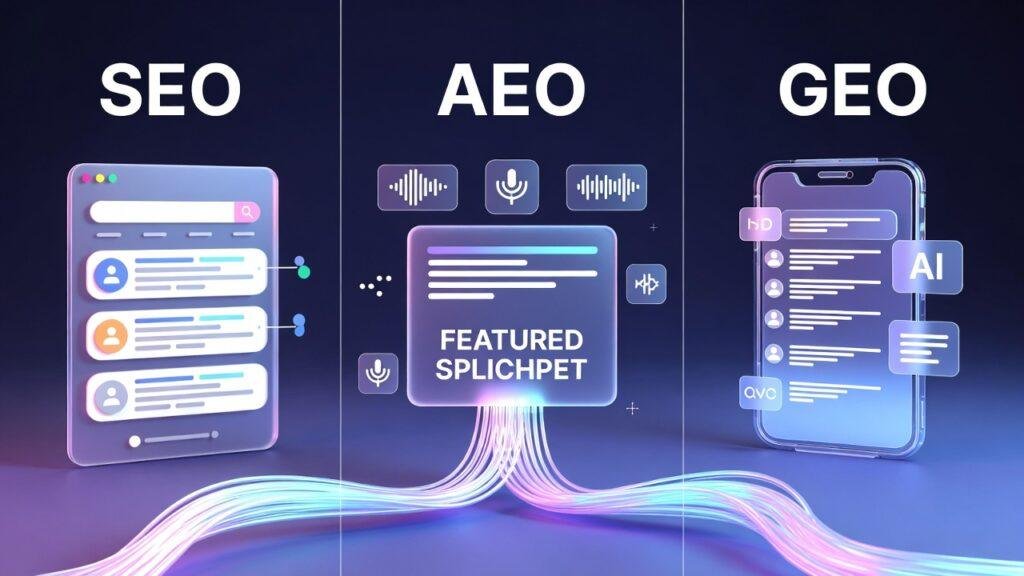
Digital search has evolved dramatically over the past decade. Businesses once focused only on ranking websites in traditional search engines, but today optimization extends beyond rankings to instant answers and AI-generated responses. This shift has introduced three major optimization disciplines: SEO (Search Engine Optimization), AEO (Answer Engine Optimization) and GEO (Generative Engine Optimization). Understanding the differences between these approaches is essential for modern marketers and businesses aiming to maintain visibility across all discovery channels.
What is SEO (Search Engine Optimization)?
Search Engine Optimization refers to the process of improving a website’s visibility in traditional search engine results pages (SERPs) on platforms like Google and Bing. The primary objective of SEO is to drive organic traffic by ranking web pages higher for targeted keywords.
SEO typically involves a combination of:
- Keyword research to identify user search intent
- On-page optimization including titles, meta descriptions, and content structure
- Technical SEO such as site speed, mobile friendliness, and crawlability
- Link building to establish domain authority
- Content marketing focused on valuable and relevant information
In a traditional SEO scenario, users search for a query, review ranked links, and click through to websites for detailed information. While SEO remains a foundational digital marketing strategy, its dominance is being challenged by zero-click searches and AI-generated responses.
What is AEO (Answer Engine Optimization)?
Answer Engine Optimization focuses on structuring content so search platforms can extract direct answers and present them instantly to users. Instead of emphasizing rankings alone, AEO prioritizes being featured in:
- Featured snippets
- People Also Ask sections
- Voice search responses
- Knowledge panels
- Quick answer boxes
The goal of AEO is position-zero visibility, where users receive immediate answers without needing to visit a website.
Key AEO strategies include:
- Creating clear, concise definitions and explanations
- Implementing structured data and schema markup
- Developing FAQ sections and conversational content
- Using question-based headings aligned with user queries
- Strengthening authority and trust signals (E-E-A-T principles)
AEO reflects the growing behavior of users seeking instant answers rather than browsing multiple pages. This trend is particularly evident with voice assistants and mobile search.
What is GEO (Generative Engine Optimization)?
Generative Engine Optimization is the newest optimization discipline emerging alongside AI-driven search systems. GEO focuses on ensuring content is discoverable and referenced within AI-generated answers produced by platforms such as OpenAI tools and Perplexity AI.
Unlike traditional search engines that list links, generative engines synthesize information from multiple sources to produce conversational responses. GEO therefore prioritizes becoming a trusted source within AI knowledge ecosystems.
Core GEO strategies include:
- Building strong topical authority through content clusters
- Establishing brand mentions across credible websites
- Providing original insights, case studies, and proprietary data
- Using entity-based content rather than keyword stuffing
- Writing context-rich and conversational content optimized for AI comprehension
- Maintaining consistent brand signals across the web
GEO represents a shift from ranking pages to influencing AI knowledge graphs and answer generation models.
Key Differences Between SEO, AEO, and GEO
The primary distinction between these optimization models lies in how users receive information.
SEO centers on rankings and organic traffic. Users must click through to websites to access information.
AEO emphasizes instant answers, often resulting in zero-click searches where visibility matters more than traffic.
GEO focuses on AI-generated responses, where businesses aim to be referenced or cited as authoritative sources within conversational answers.
Another critical difference is optimization methodology. SEO relies heavily on keywords and backlinks, AEO prioritizes structured and concise answers, while GEO emphasizes semantic depth, entity authority, and contextual relevance.
Why Businesses Must Adopt All Three Strategies
The modern search ecosystem is no longer linear. Users move between traditional search engines, voice assistants, and AI chat platforms seamlessly. As a result, relying on a single optimization approach can limit visibility.
A comprehensive strategy should include:
- SEO for sustainable organic traffic
- AEO for instant answer visibility and voice search reach
- GEO for AI search presence and brand authority within generative responses
Businesses that integrate all three approaches create a multi-layered search presence that captures users at every stage of their discovery journey.
Final Insight
SEO, AEO, and GEO represent the evolution of digital search from link discovery to answer delivery and finally to AI knowledge synthesis. While SEO remains the foundation of online visibility, AEO and GEO are rapidly shaping how users interact with information.
The future of search optimization will not be about choosing between these approaches but combining them strategically. Organizations that adapt early to this hybrid model will achieve stronger visibility, authority, and brand recognition in the AI-driven search landscape.